
Digital Marketing
What Is Digital Marketing? Types, Benefits, Strategies & Examples for Businesses in 2026
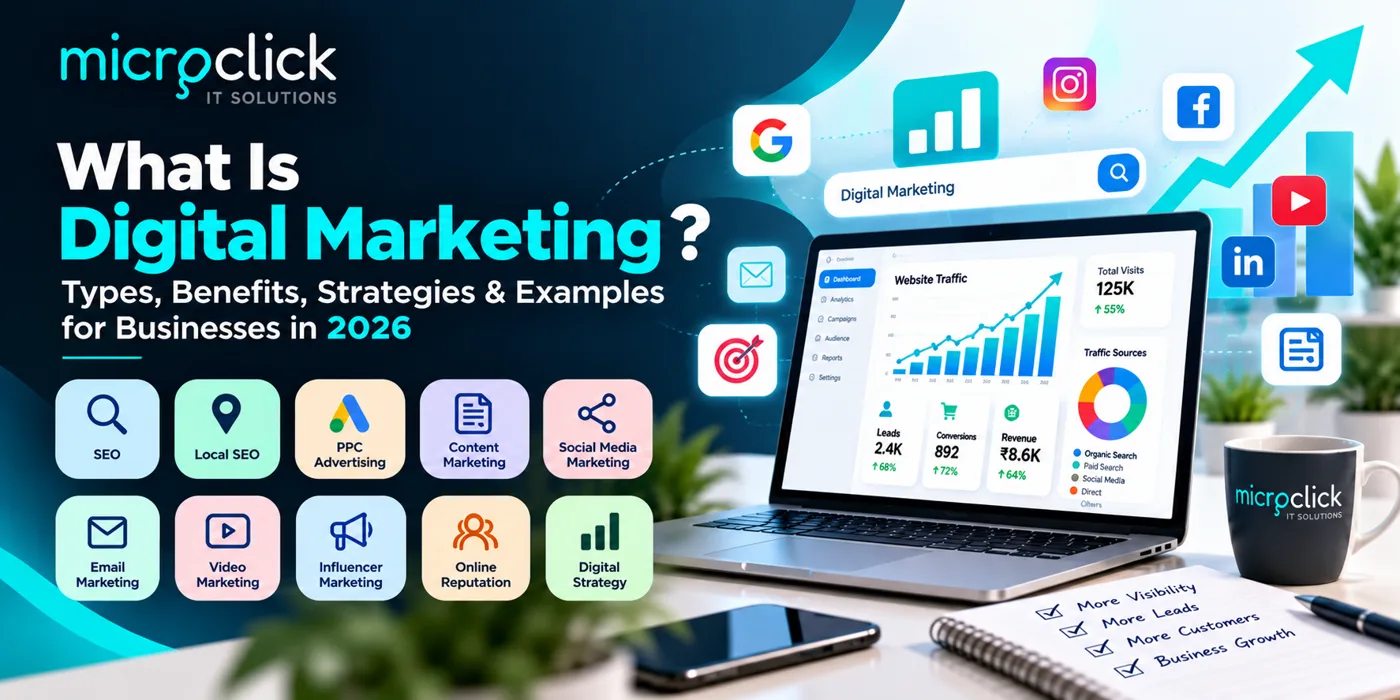
Customers no longer discover businesses through one channel.
Someone may first see a business on Instagram, search its name on Google, read reviews, visit its website, compare alternatives, return through a remarketing ad and finally submit an enquiry or make a purchase.
Digital marketing is the use of digital channels, platforms, content and technology to promote a business, connect with potential customers and achieve measurable marketing goals. It can include SEO, paid search, social media, content marketing, email, video, local search and other online channels.
For businesses in 2026, the challenge is no longer simply being online. It is being discoverable, credible and useful wherever customers research and make decisions—including traditional search engines, social platforms, maps, video platforms and AI-powered search experiences.
This guide explains what digital marketing means, its major types, benefits, practical examples and how businesses can build an effective strategy.
What Is Digital Marketing?
Digital marketing is the practice of using websites, search engines, social media, email, online advertising, content and other digital channels to attract, engage and convert an audience.
Unlike marketing through only traditional media such as newspapers, radio or outdoor advertising, digital marketing can often connect campaign activity to measurable actions such as website visits, phone calls, enquiries, purchases, bookings and other conversions.
Digital marketing can support several objectives:
- Building brand awareness
- Increasing website traffic
- Generating leads and enquiries
- Attracting local customers
- Selling products or services
- Improving customer engagement
- Retaining existing customers
- Building long-term search visibility
The right combination depends on the business, customer journey, budget, competition and objective.
How Does Digital Marketing Work?
Digital marketing works by connecting a business with potential customers across the digital journey—from initial discovery to conversion and retention.
A simplified customer journey looks like:
Discovery → Research → Comparison → Decision → Conversion → Retention
Different digital channels contribute at different stages.
For example, imagine someone in Jodhpur needs a website for a new business.
They might:
- Search Google for a website development company.
- Discover a company through organic search or a paid ad.
- Check its Google Business Profile and reviews.
- Visit the website.
- Read its services or educational content.
- Check its social media presence.
- Return later through search or another digital touchpoint.
- Submit an enquiry.
Digital marketing is therefore not one advertisement or one social media account. It is a connected system of digital touchpoints that helps move potential customers toward a business objective.
What Are the Main Types of Digital Marketing?
Businesses do not need to use every available channel. They need the channels that match how their customers discover, evaluate and buy.
1. Search Engine Optimization (SEO)
SEO is the process of improving a website's visibility in organic search results so relevant users can discover its pages when searching for information, products or services.
SEO typically includes:
- Keyword and search-intent research
- Helpful content creation
- On-page optimization
- Technical SEO
- Internal linking
- Website architecture
- Link and authority development
- Image and video optimization
- Measurement and continuous improvement
In 2026, modern SEO extends beyond simply trying to rank a webpage for a keyword. Search increasingly includes AI-assisted and multimodal discovery experiences.
2. Local SEO
Local SEO helps businesses improve their visibility when people search for products or services in a particular geographic area.
It is particularly relevant to restaurants, clinics, professional services, retailers and service providers.
Local SEO can involve:
- Google Business Profile optimization
- Accurate business information
- Local landing pages
- Reviews and reputation signals
- Local keyword targeting
- Relevant local citations
- Locally useful website content
For example, a business serving Jodhpur may want to become visible for relevant searches involving its service and location—not merely attract traffic from users it cannot realistically serve.
For local businesses in Rajasthan, relevance and geographic intent matter more than repeatedly inserting location names into content.
3. Pay-Per-Click (PPC) and Search Advertising
Paid search allows businesses to advertise to people searching for relevant products or services.
Paid advertising can be particularly useful when a business wants:
- Immediate targeted visibility
- Lead generation
- Product sales
- Campaign-specific traffic
- Measurable customer acquisition
- Testing of offers or landing pages
SEO and PPC should not automatically be viewed as competitors. For many businesses, they serve different time horizons and customer-acquisition needs.
4. Content Marketing
Content marketing uses useful information to attract, educate and influence an audience.
Formats can include:
- Blog articles
- Guides
- Videos
- Case studies
- FAQs
- Infographics
- Comparison pages
- Tutorials
- Research
- Social content
A website development company, for example, could publish a practical guide explaining what businesses should check before choosing a website platform.
The objective is not simply to publish blogs. Good content answers questions that matter to potential customers and connects those answers naturally with the business's expertise.
5. Social Media Marketing
Social media marketing uses platforms where audiences communicate, discover content and interact with brands.
Depending on the audience and business model, this may include platforms such as Instagram, Facebook, LinkedIn and YouTube.
Social media can support:
- Brand awareness
- Audience engagement
- Product discovery
- Community building
- Website traffic
- Lead generation
- Customer communication
- Paid advertising
A local restaurant and a B2B technology company should not automatically follow the same social strategy. Platform selection should follow the audience, not trends alone.
6. Email Marketing
Email marketing allows businesses to communicate directly with people who have chosen to receive communication from them.
Common uses include:
- Lead nurturing
- Product announcements
- Educational newsletters
- Offers
- Customer onboarding
- Abandoned-cart communication
- Re-engagement
- Customer retention
The strength of email is that a business can build a direct relationship with an audience rather than relying entirely on third-party platform algorithms.
7. Video Marketing
Video can be used across websites, social platforms, YouTube, advertising and product education.
Businesses can use video for:
- Product demonstrations
- Educational explainers
- Customer questions
- Brand storytelling
- Short-form social content
- Genuine customer testimonials
- Tutorials
- Advertising
As visual and multimodal search develops, useful visual assets can also become part of a broader search-discovery strategy.
8. Influencer and Creator Marketing
Creator marketing involves working with individuals who have relevant audiences or authority within a niche.
Businesses should evaluate:
- Audience relevance
- Credibility
- Engagement quality
- Brand alignment
- Content quality
- Campaign objective
- Measurement method
For a local business, a smaller creator with a genuinely relevant local audience may be more strategically useful than a much larger but geographically irrelevant audience.
9. Affiliate Marketing
Affiliate marketing rewards external publishers, creators or partners for generating defined results such as sales or qualified leads.
It can be useful for businesses with appropriate products, margins and tracking systems, but it requires clear attribution, partner management and commercial terms.
10. Online Reputation and Review Marketing
Reviews influence how potential customers evaluate businesses, particularly in local search.
Reputation management can include:
- Encouraging genuine customer feedback
- Responding professionally to reviews
- Monitoring important review platforms
- Addressing recurring customer concerns
- Keeping business information accurate
Reviews should be treated as customer-experience feedback, not merely an SEO tactic.
Digital Marketing vs Traditional Marketing
Neither digital nor traditional marketing is automatically superior. The best choice depends on audience behavior and business objectives.
| Factor | Digital Marketing | Traditional Marketing |
|---|---|---|
| Channels | Search, websites, email, social, apps, video | Print, radio, television, outdoor |
| Targeting | Can be highly specific | Often broader |
| Measurement | Often detailed and near real-time | Can be harder to attribute directly |
| Interaction | Often two-way | Commonly one-way |
| Optimization | Campaigns can often be adjusted quickly | Changes may require longer cycles |
| Geographic Reach | Local to global | Depends heavily on medium |
| Personalization | Often possible | Usually more limited |
Many businesses use both. The decision should be based on where the target audience spends attention and which channels can realistically contribute to the objective.
What Are the Benefits of Digital Marketing for Businesses?
Reach Customers at the Right Moment
Search marketing can reach people who are already expressing intent.
Someone searching “SEO services in Jodhpur”, for example, is displaying a clearer need than a broad audience that happens to see an unrelated advertisement.
Measure Performance More Clearly
Digital platforms can provide data such as impressions, clicks, engagement, leads, conversion rates, acquisition costs, revenue and return on advertising spend.
Not every interaction can be attributed perfectly, but digital marketing generally provides substantial measurement opportunities.
Build Both Short- and Long-Term Growth Channels
Paid advertising can generate visibility quickly, while SEO, content and brand development can build assets with longer-term value.
A balanced strategy does not necessarily choose one or the other.
Improve Local Visibility
Digital marketing allows local businesses to connect marketing with geographic intent.
For businesses in Jodhpur, that may mean combining a well-designed website, Local SEO, Google Business Profile optimization, relevant content, reviews and targeted advertising.
Learn From Customer Behavior
Search queries, website analytics, advertising data, enquiries and conversion behavior can reveal what customers are interested in and where the buying journey creates friction.
The purpose of analytics should be decision-making, not simply generating reports.
Compete More Strategically
Smaller businesses may not be able to outspend national brands.
They can, however, compete in narrower areas through strong local relevance, specialized expertise, better customer experience, useful niche content and focused advertising.
What Is a Digital Marketing Strategy?
A digital marketing strategy is a structured plan that defines which customers a business wants to reach, what outcomes it wants to achieve, which digital channels it will use, what content or offers it will provide and how performance will be measured.
Posting regularly on social media is an activity.
Running Google Ads is an activity.
Publishing blog posts is an activity.
A strategy connects those activities to a defined business objective.
How to Create a Digital Marketing Strategy in 2026
Step 1: Define the Business Objective
Start with the outcome, not the platform.
Examples include generating qualified leads, increasing online sales, attracting local customers, improving brand awareness, increasing repeat purchases and growing organic search visibility.
Avoid vague goals such as “do more digital marketing.”
Step 2: Understand Your Target Customer
Identify:
- Who needs the product or service?
- What problem are they trying to solve?
- Where do they search?
- What questions do they ask?
- What stops them from buying?
- What information builds trust?
- Which platforms influence their decisions?
This determines where marketing resources should be allocated.
Step 3: Build a Strong Digital Foundation
Marketing cannot compensate indefinitely for a poor digital experience.
Before aggressively increasing traffic, check whether your website provides:
- Clear positioning
- Mobile usability
- Fast and accessible pages
- Useful service or product information
- Logical navigation
- Trust information
- Clear calls to action
- Reliable enquiry or checkout functionality
- Appropriate analytics and conversion tracking
Step 4: Choose Channels Based on Intent
Do not select platforms merely because competitors use them.
A local service business might prioritize:
Local SEO + Google Business Profile + SEO + Search Ads
An ecommerce brand may prioritize:
Shopping/Performance Advertising + Social Media + Email + Content + SEO
A B2B company might focus on:
SEO + Expert Content + LinkedIn + Email + Paid Search
Channel selection should reflect the customer journey.
Step 5: Create Content for Real Customer Questions
Map content to different stages.
Awareness: Educational guides and videos.
Consideration: Comparisons, detailed service information and FAQs.
Decision: Product/service pages, proof, pricing information where appropriate and clear calls to action.
Retention: Email, support content and customer education.
Content should help a customer progress rather than exist merely because a publishing calendar requires another article.
Step 6: Connect SEO With AI-Era Search
Search in 2026 is not limited to traditional blue links.
Businesses should create content that is technically accessible, factually reliable, original and useful enough to serve users across conventional results and AI-assisted experiences.
For GEO and AI-search visibility:
- Answer important questions directly.
- Make entities and relationships clear.
- Provide original business knowledge.
- Cite authoritative sources where appropriate.
- Keep important information current.
- Structure pages logically.
- Use descriptive images and video where useful.
- Maintain strong technical SEO.
The goal should not be producing content simply for AI systems. It should be producing information valuable enough for both people and search systems to understand and trust.
Step 7: Measure Business Outcomes
Choose metrics that correspond to the objective.
For awareness, evaluate relevant reach, branded search and qualified engagement.
For lead generation, measure qualified enquiries, conversion rate, cost per lead and lead quality.
For ecommerce, measure purchases, conversion rate, customer acquisition cost, revenue and return on advertising spend.
For SEO, evaluate relevant organic visibility, search clicks, landing-page engagement and leads or revenue from organic search.
Traffic without business relevance is not necessarily success.
Step 8: Test and Improve
Digital marketing is iterative.
Analyze:
- What attracted the right users?
- What converted?
- Where did users leave?
- Which content generated useful engagement?
- Which campaigns generated qualified customers rather than cheap clicks?
Then improve the strategy based on evidence.
Practical Digital Marketing Examples
Example 1: A Local Service Business in Jodhpur
A local service provider wants more enquiries.
A practical strategy might combine:
Google Business Profile Optimization → Local SEO → Service Pages → Customer Reviews → Google Search Ads → Conversion Tracking
The objective is not nationwide traffic. It is visibility among relevant people in the service area who have genuine intent.
Example 2: A New Ecommerce Business
An online store needs both discovery and repeat customers.
Its strategy could combine:
Product-Page SEO → Shopping/Performance Advertising → Social Content → Email Capture → Remarketing → Retention Campaigns
The exact mix should depend on margins, customer acquisition economics and where the audience shops.
Example 3: A B2B Company
A B2B service provider may have a longer buying cycle.
Its strategy could include:
Expert Content → SEO → LinkedIn Distribution → Search Advertising → Lead Capture → Email Nurturing → Sales Follow-Up
In this scenario, measuring only the first click would provide an incomplete picture.
Digital Marketing in 2026: What Has Changed?
Search Is Becoming More Multimodal
Search discovery increasingly extends beyond typed keywords to images, visual search, video and AI-assisted experiences.
For marketers, useful visual assets should therefore be treated as content—not decoration alone.
AI Is Becoming Part of Marketing Workflows
Generative AI can assist with research, organization, ideation, content production and analysis.
A sensible workflow is:
Research → Strategy → AI Assistance → Human Expertise → Verification → Editing → Publication → Measurement
AI can improve efficiency, but businesses still need human accountability for accuracy, positioning, strategy and quality.
Privacy and First-Party Data Matter
Businesses collecting customer information through forms, email subscriptions, advertising systems and customer databases should treat privacy and responsible data handling as part of their marketing operations.
This is especially important as privacy and data-protection requirements continue to develop in India and internationally.
Search Visibility Extends Into AI Experiences
Customers increasingly discover businesses and information through AI-assisted search experiences in addition to traditional search results.
The strategic lesson is straightforward:
Build a brand and website people want to find, understand and trust rather than optimizing only for one search-result format.
Common Digital Marketing Mistakes Businesses Should Avoid
The most common problem is not a lack of marketing tools. It is a lack of strategic connection between them.
Avoid:
- Running ads without reliable conversion tracking
- Buying traffic before fixing a weak website
- Publishing SEO content without understanding search intent
- Treating follower count as the main social media KPI
- Creating large amounts of generic AI content
- Targeting every available platform
- Ignoring local search when customers are geographically concentrated
- Measuring traffic without evaluating lead or customer quality
- Neglecting existing customers while constantly pursuing new ones
- Making marketing decisions from insufficient data without considering the buying cycle
A smaller, well-measured strategy can be more valuable than being active everywhere.
How Much Does Digital Marketing Cost?
There is no universal digital marketing budget that works for every business. Cost depends on the market, competition, objectives, channels, geographic reach, content requirements, advertising spend and internal resources.
A useful approach is to divide investment into:
Foundation: Website, analytics, conversion tracking and technical setup.
Organic Growth: SEO, Local SEO and content.
Paid Acquisition: Search, social, display or other advertising.
Retention: Email, remarketing and customer communication.
Measurement: Analytics, reporting and optimization.
Businesses should evaluate digital marketing by sustainable customer-acquisition economics and business outcomes rather than selecting a budget based solely on what competitors appear to spend.
How Long Does Digital Marketing Take to Work?
The answer depends on the channel.
Paid advertising can begin generating visibility once campaigns are running, although effective optimization requires sufficient data and testing.
SEO and content marketing generally require a longer-term approach because websites need to build relevance, useful content, technical quality and authority.
Social media performance depends heavily on audience, format, consistency and distribution.
Instead of asking only, “How quickly will this work?”, businesses should ask:
What should we reasonably expect from this channel, how will we measure it and when will we review whether the strategy is working?
Digital Marketing for Businesses in Jodhpur and Rajasthan
For many businesses in Jodhpur and Rajasthan, digital marketing does not need to begin with a complex national campaign.
A local business can start by ensuring customers can:
- Find it through relevant Google searches.
- Discover accurate information through its Google Business Profile.
- Visit a professional mobile-friendly website.
- Understand its services quickly.
- See genuine reputation signals.
- Contact the business easily.
- Continue interacting through appropriate digital channels.
From there, SEO, paid advertising, social media, content and other channels can be expanded according to business objectives.
The priority should be relevant visibility, not visibility for its own sake.
How MicroClick Can Help With Digital Marketing
Digital marketing works best when the individual parts—website, search visibility, local presence, content, social media and technology—support the same business objective.
MicroClick is an IT and digital solutions company based in Jodhpur, Rajasthan, offering digital marketing, SEO, Local SEO, Google Business Profile optimization, website design and development, social media marketing, web solutions and IT solutions.
For businesses that need to strengthen their digital presence, the starting point is identifying where the current customer journey is weak: discovery, website experience, search visibility, local visibility, engagement or conversion.
From there, the appropriate combination of digital services can be selected rather than adopting channels simply because they are popular.
Frequently Asked Questions About Digital Marketing
What is digital marketing in simple words?
Digital marketing means promoting and growing a business through digital channels such as Google Search, websites, social media, email, online advertising and video. It helps businesses reach potential customers, communicate with them and measure actions such as visits, enquiries, purchases or bookings.
What are the main types of digital marketing?
The main types include SEO, Local SEO, paid search/PPC, content marketing, social media marketing, email marketing, video marketing, display advertising, affiliate marketing, creator marketing and online reputation management. Businesses usually combine selected channels rather than using every type.
Why is digital marketing important for small businesses?
Digital marketing can help small businesses reach audiences based on search intent, geography and other relevant factors; measure performance; improve local visibility; generate leads; and build longer-term digital assets such as a website, content and organic search presence.
Is SEO part of digital marketing?
Yes. SEO is an important digital marketing discipline focused on improving organic search visibility. It works particularly well when connected with website development, content strategy, Local SEO, analytics and conversion optimization.
What is the difference between SEO and digital marketing?
Digital marketing is the broader discipline. SEO is one component within it. Digital marketing may include SEO alongside paid advertising, social media, email, content, video and other channels. SEO specifically focuses on earning relevant organic search visibility.
Can digital marketing work for local businesses?
Yes. Local businesses can use Local SEO, Google Business Profile optimization, locally relevant website pages, reviews, search advertising and social media to reach potential customers within their service area.
Is AI replacing digital marketing?
No. AI is changing how some marketing tasks are performed, but businesses still need strategy, customer understanding, creative judgment, accurate information, positioning, measurement and accountability. AI is most useful when it supports these functions rather than being treated as a substitute for them.
What is the best digital marketing strategy in 2026?
There is no single best strategy. A strong approach starts with a clear business objective and customer understanding, then selects the most relevant channels, builds a strong website and measurement foundation, creates useful content, measures conversions and continuously improves based on results.
Conclusion
Digital marketing is not simply social media posting, SEO or running advertisements. It is the coordinated use of digital channels to help the right audience discover, evaluate, choose and continue engaging with a business.
In 2026, the fundamentals remain important even as AI-assisted search, multimodal discovery and automation change how customers find information.
Businesses should focus on strong digital foundations, useful content, search visibility, customer experience, reliable measurement and channels that match actual customer behavior.
For local businesses in Jodhpur, organizations across Rajasthan or companies targeting wider markets, the best digital marketing strategy is not the one using the most platforms. It is the one connecting the right channels to measurable business objectives.
Ready to Turn Your Digital Presence Into Business Growth?
Knowing what digital marketing is only matters when you turn the right strategies into action.
Whether your business needs better Google visibility, stronger local search rankings, a high-performing website, more qualified leads or a more effective digital marketing strategy, MicroClick can help you build the right digital foundation for sustainable online growth.
MicroClick is an IT & Digital Solutions Company in Jodhpur, Rajasthan, providing:
- Digital Marketing
- Search Engine Optimization (SEO)
- Local SEO
- Google Business Profile / GMB Optimization
- Website Design & Development
- Social Media Marketing
- Web Solutions
- IT Solutions
- Online Brand Growth
- Digital Business Solutions
Instead of using disconnected marketing tactics, build a digital strategy around your business goals, target audience and customer journey.
Let’s Build a Stronger Digital Presence for Your Business
If you’re looking to improve your search visibility, local presence, website performance, lead generation or overall online growth, connect with MicroClick to discuss the digital solutions that fit your business.
Ready to grow your business online? Contact MicroClick today and take the next step toward a stronger, more visible and more effective digital presence.